What sets AI agents apart from chatbots? Explore how AI agents complete tasks, automate business workflows, and help organizations get more value from AI.
What you will learn in this article:
What AI agents and chatbots are and how their capabilities differ.
How AI agents can complete tasks across business systems, beyond generating answers.
Practical examples of AI agents for business automation.
What businesses need to connect AI agents to existing applications safely.
How to measure the business value and ROI of AI agents.
AI chatbots have become common tools for answering questions, finding information, and supporting everyday tasks. But for many businesses, employees are still responsibly for acting on the answers they receive.
As organizations look to get more value from their AI investments, attention is shifting toward AI agents that can complete tasks across existing business systems. These agents can help teams move beyond generating responses to automating parts of their daily operations.
In this article, we'll explore the differences between AI agents and chatbots, how they support business automation, and what organizations should consider before introducing agents into their workflows.
What are AI chatbots and AI agents?
AI chatbot: A software application designed to communicate with users through natural language. Chatbots can answer questions, retrieve information, and help users complete tasks. Some follow predefined rules, while others use generative AI to understand requests and produce responses.
AI agent: An AI-powered system designed to complete tasks or work toward a specific goal. Depending on its tools and permissions, an agent can access business applications, plan actions, update information, and check the results of its own work.
Operational AI: The use of artificial intelligence to support and improve everyday business operations. This can include analyzing information, supporting decisions, and automating tasks across different systems and departments of the enterprise.
AI agents vs chatbots: What is the difference?
The main difference between AI agents and chatbots is how they approach tasks and how much work they can perform independently.
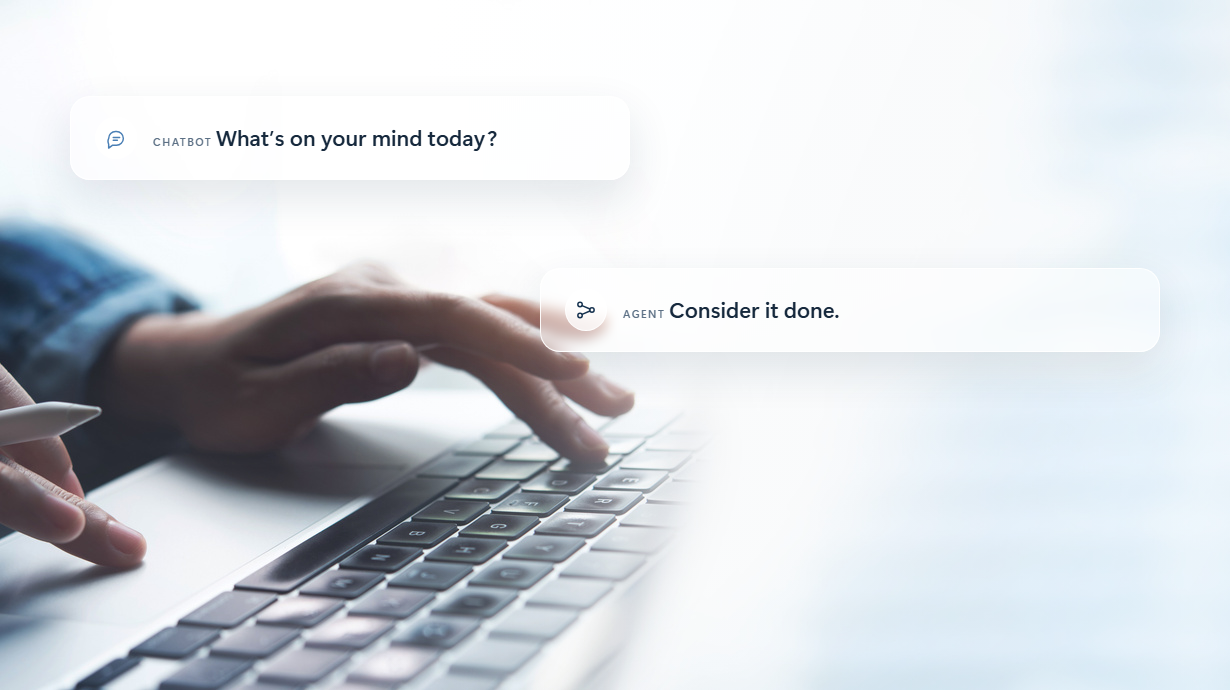
Chatbots are generally designed around conversations. They respond to questions, provide information, and help uses with specific requests. AI agents are designed to work toward goals, which may involve planning several steps, using business applications, and taking actions with defined permissions.
The two can overlap. Modern chatbots may include agent capabilities,allowing them to perform actions as well as answer questions.
AI agent's vs chatbots comparison
Below are typical characteristics of AI chatbots, AI assistnats, and AI agents:
| Capability | AI Chatbot | AI Assistant | AI Agent |
|---|---|---|---|
| Primary output | Answer questions and support conversations | Help users complete tasks | Work toward assigned goals |
| Typical interaction | Conversation | User requests and commands | User requests or configured triggers |
| Task execution | May perform actions if connected to tools | Can perform supported tasks | Can coordinate several actions |
| Independence | Usually responds to users | Generally works with user direction | May complete multiple steps with limited supervision |
| System access | Depends on available connections | Depends on available tools | Can use connected applications and tools |
| Memory and context | Varies by application | Varies by application | May retain task progress and relevant history |
| Human involvement | Usually conversational | Often frequent | Depends on permissions and approvals |
| Example | Answer an inventory question | Help prepare a purchase request | Check stock, prepare a request, and route it for approval |
From generating answers to completing operational tasks
AI agents for business automation use available tools and business information to complete tasks across connected applications. Rather than stopping after providing an answer, an agent can carry out several steps toward a defined goal.
For example, when an employee asks about inventory levels, a chatbot might retrieve a report or summarize available stock. An AI agent could check inventory, identify a shortage, prepare a purchase order, and send it to the purchasing manager for approval.
The difference becomes especially useful when a business process involves several applications or requires multiple steps to complete.
AI assistants also help employees complete work, such as writing emails, scheduling meetings, or finding information. Some assistants can perform actions through connected applications and may use AI agents behind the scenes.
The distinction depends on how the technology is designed and used. An assistant typically helps someone carry out a task, while an agent may handle several steps with less direct guidance.
How AI agents complete multi-step tasks
AI agents can break a goal into smaller steps and use available tools to carry out each one.
For example, an agent updating a customer record might first retrieve the correct account, check the new information, and then save the changes. If an error occurs, the agent may be able to review the problem and try another approach or request human assistance.
This allows agents to handle workflows that involve more than a single request or response.
Practical examples of AI agents in business automation
AI agents for business automation can help organizations manage repetitive tasks, work across applications, and respond to changing information.
Traditional automation works well for processes that follow clear rules. AI agents can be useful when a task also requires interpreting information, choosing between actions, or coordinating several steps.
Here are some examples of how businesses can use AI agents in everyday operations.
Inventory Management: An AI agent monitors stock levels in an ERP system such as Microsoft Dynamics 365 Business Central. When a part drops below the minimum threshold, it can check supplier information, compare pricing and lead times, prepare a purchase order, and send it to a manager for approval.
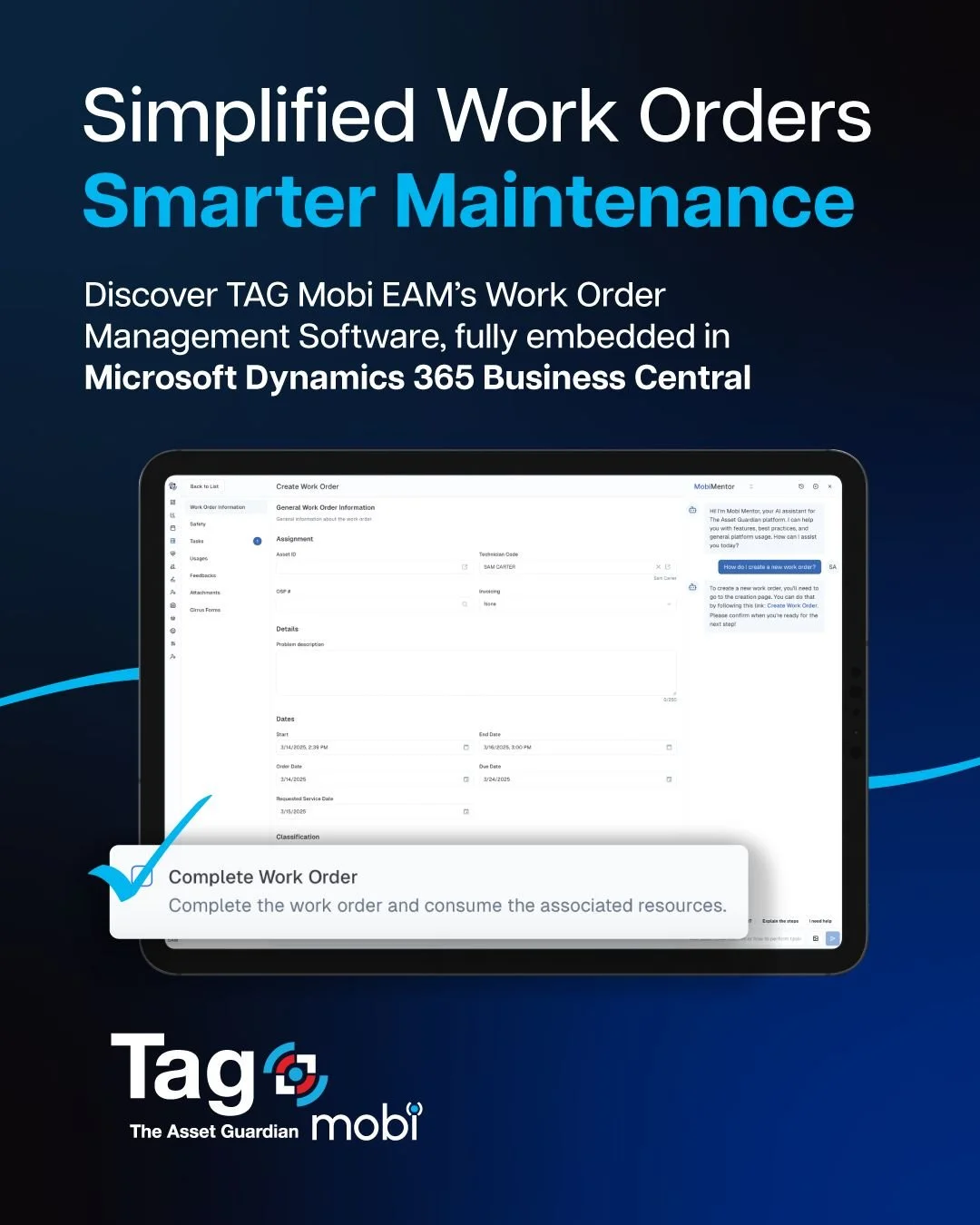
Maintenance Scheduling: Instead of a coordinator manually balancing technician workloads, an AI agent reviews open work orders, checks technician certifications and locations, and prepares a proposed maintenance schedule based on priorities and travel distances.
Customer Service: An AI agent receives a customer request, retrieves the relevant account information, checks the order status, and updates the customer service record. If additional action is needed, it can prepare a follow-up task or notify the appropriate employee.
Finance: An AI agent identifies an invoice discrepancy, compares the invoice with purchase orders and receiving records, and prepares a request for correction. It can then notify the appropriate employee or supplier and route the issue for review.
What businesses need before deploying AI agents
For AI agents to work reliably, they need access to accurate business information and the right permissions to use connected systems.
Before introducing AI agents into daily operations, businesses should identify what information agents need, which actions they can perform, and when employees must review their work.
System connections: Agents need ways to access information and interact with existing applications, such as Microsoft 365, Dynamics 365, ERP, and Enterprise Asset Management (EAM) systems. This may involve APIs, connectors, or tools that allow agents to use software.
Accurate business data: Agents need relevant and reliable information to complete their tasks and make appropriate decisions.
Permissions: Organizations must define what information an agent can access and which actions it is allowed to perform.
Human approvals: Financial transactions, sensitive information, and actions with safety implications may require employee approval before proceeding.
Monitoring and verification: Businesses need ways to check whether tasks were completed correctly, review agent activity, and respond when something goes wrong.
How do businesses measure the value of AI agents?
Measuring the value of AI agents requires looking at the work they complete, not simply how quickly they respond.
While chatbot performance may be measured through response quality and user satisfaction, AI agents can also be evaluated based on completed tasks, time saved, accuracy, and operating costs.
Businesses should compare these results against the time and resources previously required to complete the same work.
Task Completion Rate: The percentage of assigned tasks or workflows completed successfully, including those that require planned human approvals.
Process Duration: The time required to complete a task or workflow compared with the previous process.
Error Reduction: Changes in the number of errors, missed steps, or corrections needed.
Manual Work Reduction: The amount of employee time saved on repetitive or administrative tasks.
Cost per Completed Task: The cost of operating the agent, including technology and human review, compared with the cost of completing the same work manually.
Put AI Agents to Work with Verovia
AI agents help businesses turn information into action by carrying out tasks across existing systems and reducing the manual work required to keep operations moving.
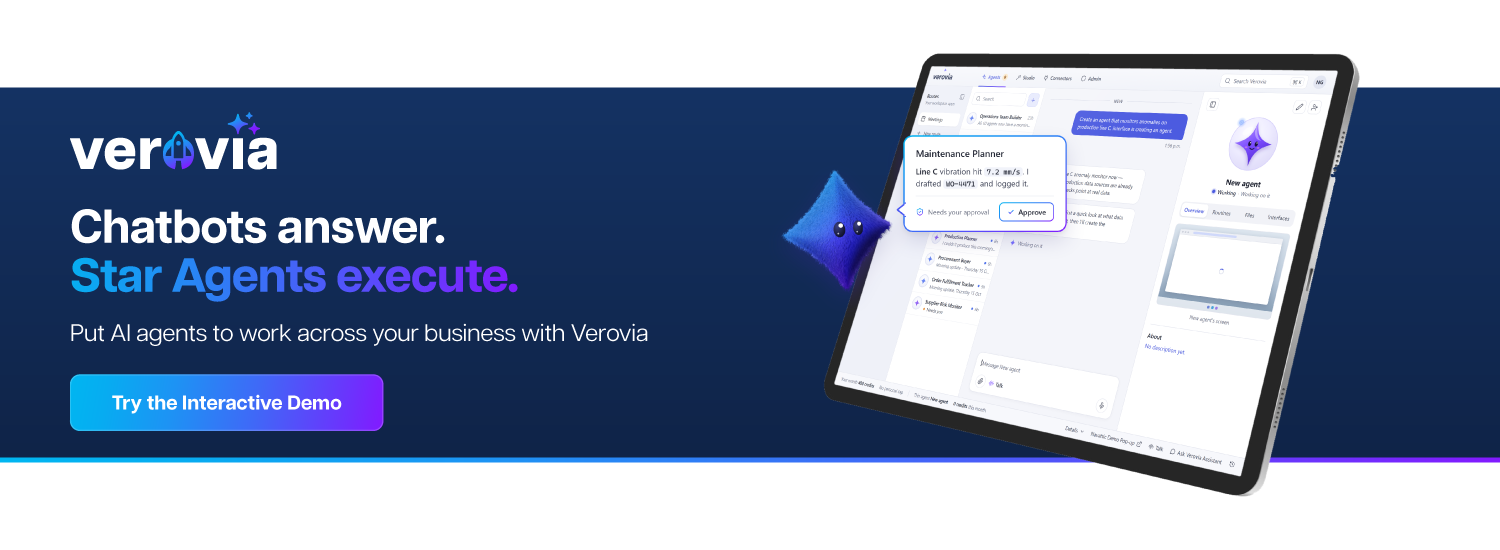
With Verovia, you can create AI agents that take on real business tasks, from updating records and retrieving information to coordinating work across departments. Give an agent a role, connect it to your existing applications, and let it carry out multi-step tasks, even after you close your browser. Set permissions and approval requirements to keep control over what your agents can do.
Ready to give your first AI agent a job? Try Verovia for free.
FAQ
What is the difference between an AI agent and an AI chatbot?
An AI chatbot is primarily designed to communicate with users, answer questions, and provide information. An AI agent is designed to work toward a goal by carrying out tasks using available tools and applications. Their capabilities can overlap, as modern chatbots may also include agent features.
Can AI agents perform tasks that chatbots cannot?
AI agents can perform multi-step tasks such as updating records, preparing purchase orders, and coordinating work across business applications. Some modern chatbots can perform these actions too. The main difference is how the system manages tasks, makes decisions, and works toward a goal.
How do AI agents differ from generative AI and AI assistants?
Generative AI creates content such as text, images, and code. AI assistants help people with tasks through requests or conversations. AI agents can use generative AI and other tools to carry out actions toward a defined goal. These technologies often work together.
Can AI agents automate business processes across multiple systems?
Yes. AI agents can use connectors, APIs, and other tools to work with applications such as CRM, ERP, and maintenance systems. Depending on their permissions, agents can retrieve information, update records, and coordinate tasks across different applications.
How can businesses measure the ROI of AI agents?
Businesses can measure AI agent ROI by comparing the cost of implementing and operating agents with the value of their completed work. Useful metrics include time saved, process completion rates, error reduction, and lower administrative costs.