Industrial AI helps businesses turn data from connected systems into better decisions and automated workflows. Explore its benefits, practical use cases, and how AI agents connect industrial data with everyday operations.
What you will learn in this article:
What industrial AI is and how it differs from generative AI and enterprise AI.
How industrial AI uses data from SCADA, IoT, and ERP systems to support business operations.
Practical industrial AI use cases across manufacturing, energy, procurement, quality management, and logistics.
How AI agents can turn industrial data into automated tasks and workflows.
What businesses need to implement industrial AI safely and move projects into daily operations.
Industrial businesses collect enormous amounts of data every day. Sensors monitor equipment, SCADA systems track production, and ERP applications manage purchasing, inventory, and other business activities. But how much of that information actually leads to action?
When these systems operate separately, employees are often left interpreting data, transferring information, and coordinating the next steps manually. Even when AI identifies a problem, someone still needs to act on it.
Industrial AI helps businesses use this information to identify problems, support decisions, and improve operations. When connected with AI agents and existing business applications, it can also support automated workflows across departments.
In this article, we'll explore what industrial AI is, how it works with existing systems, and practical use cases beyond predictive maintenance. We'll also cover the requirements for moving industrial AI from experimentation into everyday operations.
What is industrial AI and how does it differ from other AI categories?
Industrial AI is the application of artificial intelligence to industrial operations, equipment, and processes. It uses data to identify patterns, predict potential problems, support decisions, and improve how industrial businesses operate.
Industrial artificial intelligence can help organizations monitor equipment performance, improve production quality, manage energy consumption, and optimize resources.
Unlike general-purpose AI applications, industrial AI often works with information generated by physical equipment and industrial systems. This can include temperature readings, vibration measurements, production data, and other information collected during daily operations.
Industrial AI can also connect this operational information with business data to help organizations make decisions that consider both equipment conditions and business requirements.
Industrial AI vs. Generative AI vs. Enterprise AI
Industrial AI, generative AI, and enterprise AI have different primary applications, but they are not mutually exclusive.
Generative AI creates content such as text, images, code, and summaries. In an industrial setting, it might help generate a work order description or summarize a maintenance report.
Enterprise AI applies artificial intelligence to business processes, such as financial forecasting, customer service, purchasing, and resource planning.
Industrial AI applies AI to industrial environments, using operational data to support equipment performance, production, reliability, and other industrial activities.
These technologies can work together. For example, an industrial AI system might detect unusual equipment behavior, while generative AI summarizes the findings and an AI agent initiates a review process in an enterprise application.
Comparison: Generative AI vs. Enterprise AI vs. Industrial AI
| Category | Primary purpose | Typical data | Example application |
|---|---|---|---|
| Generative AI | Create content and interpret information | Documents, text, images, code | Summarizing an equipment inspection report |
| Enterprise AI | Support business processes and decisions | ERP, CRM, financial, and organizational data | Forecasting inventory requirements |
| Industrial AI | Improve industrial processes and operational decisions | SCADA, IoT, equipment, production, and business data | Identifying unusual equipment behavior and supporting corrective action |
These components allow organizations to coordinate AI-driven activities across departments and applications while retaining control over the information accessed and actions performed.
How industrial AI uses SCADA, IoT, and ERP data
Industrial AI depends on information from the systems businesses use. Connecting operational and business data gives AI applications a more complete understanding of what is happening and what actions may be needed.
Three important sources of information include:
1. SCADA systems
Supervisory Control and Data Acquisition (SCADA) systems monitor and, where configured, control industrial equipment and processes.
They collect information such as temperature, pressure, equipment status, and production conditions. Industrial AI can analyze this data to identify unusual patterns, detect potential problems, and support operational decisions.
2. IoT sensors
Internet of Things (IoT) devices collect information from connected equipment and environments.
For example, sensors can track vibration, humidity, temperature, and energy consumption. AI can analyze this information over time to identify changes that may indicate equipment wear, poor performance, or unusual operating conditions.
IoT data may also be collected through SCADA systems, depending on the organization's technology.
3. ERP systems
Enterprise Resource Planning (ERP) systems manage business information such as purchasing, inventory, costs, production planning, and financial records.
Connecting ERP data with industrial AI allows organizations to consider business requirements alongside equipment and operational conditions.
Connecting industrial data to business action
Consider an industrial facility where sensors detect unusual vibration on a critical machine.
Industrial AI could analyze the readings and identify a potential equipment issue. By combining that information with ERP data, the organization could also check spare part availability, purchasing requirements, and the potential impact on production.
If connected to an AI agent with the appropriate permissions, the workflow could go further by preparing a maintenance request, notifying the responsible team, or initiating an approval process.
The result is a more coordinated response that uses information from several systems rather than relying on employees to manage every step manually.
Industrial AI use cases across business operations
Predictive maintenance is one of the most recognized industrial AI applications, but its uses extend well beyond equipment monitoring.
Industrial businesses can apply AI to production, energy management, purchasing, logistics, and other operational activities.
1. Procurement and inventory optimization
Maintaining the right inventory levels can be difficult when equipment requirements, supplier lead times, and production schedules change.
Industrial AI can analyze historical consumption, supplier information, and inventory trends to predict future requirements.
For example, an AI application might identify a potential spare parts shortage before a planned maintenance activity. When connected to purchasing systems, an AI agent could prepare a requisition for employee approval.
This can help businesses reduce unnecessary stock, lower the risk of shortages, and improve purchasing decisions.
2. Quality management and production
Production environments generate information about machine settings, operating conditions, and product quality.
Industrial AI can analyze this data to identify patterns associated with quality problems or changes in production performance.
For example, an AI system might detect unusual temperature or pressure readings during a manufacturing process and alert operators before more products are affected.
By identifying problems earlier, businesses can take corrective action and potentially reduce waste, rework, and production disruptions.
3. Industrial energy management
Energy consumption provides useful information about both operating costs and equipment performance.
Industrial AI can analyze energy usage alongside production schedules, equipment conditions, and historical consumption patterns.
For example, an unexpected increase in energy consumption could indicate inefficient equipment operation or a developing problem.
AI can help identify these changes and provide information that supports maintenance, production planning, and energy management decisions.
4. Logistics and supply chain management
Industrial businesses must coordinate materials, production schedules, suppliers, and deliveries across multiple systems.
Industrial AI can analyze inventory levels, demand forecasts, supplier lead times, and delivery information to help teams identify potential disruptions.
For example, AI could flag a delayed shipment that may affect production and help planners evaluate alternative suppliers or delivery schedules.
When connected to business applications, AI agents can support follow-up activities such as updating records or preparing requests for approval.
5. Maintenance and asset reliability
Industrial AI can analyze equipment condition, maintenance history, and operating patterns to identify potential failures.
Rather than relying only on fixed maintenance schedules, organizations can use this information to help determine when equipment may need attention.
For example, AI could identify a change in equipment performance and recommend an inspection. Connected workflows could then help maintenance teams review the issue, check available resources, and plan the necessary work.
This can help organizations prioritize maintenance activities and reduce the risk of unexpected downtime.
How AI agents support industrial automation
Industrial AI can identify problems, recognize patterns, and recommend actions. But identifying an issue does not necessarily mean the required work will get done.
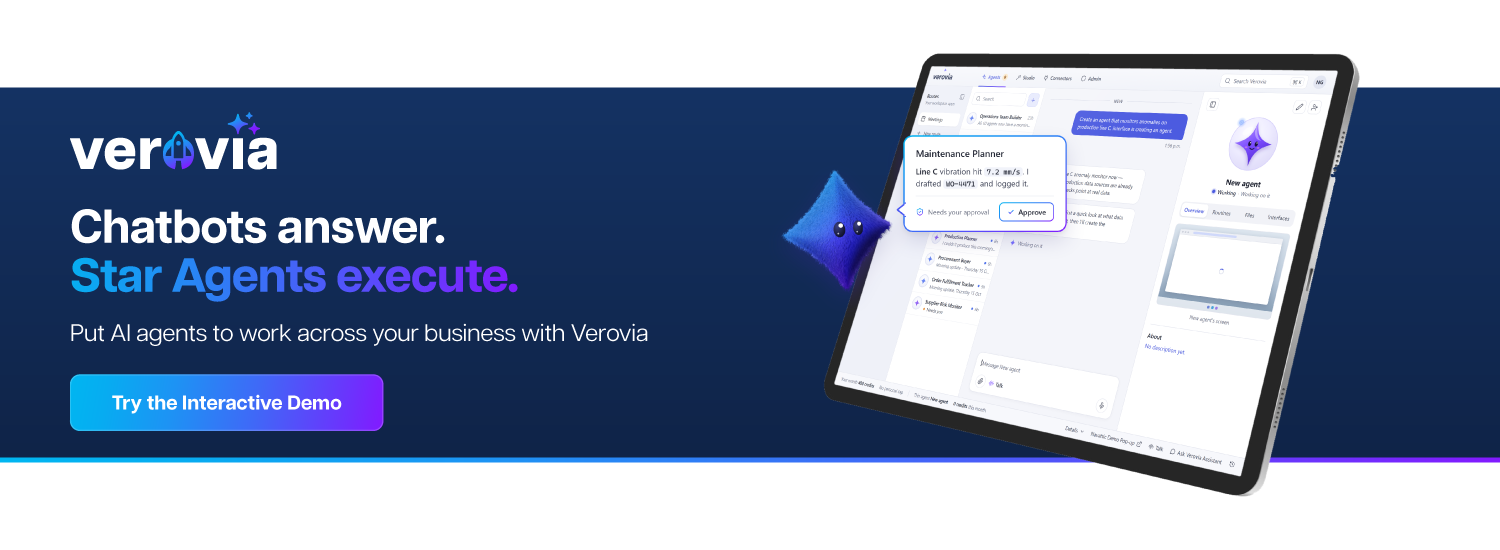
AI agents can help turn industrial information into action by interacting with existing business applications and carrying out tasks within defined permissions.
Unlike systems that only generate alerts or reports, AI agents can be configured to retrieve information, update records, coordinate tasks, and initiate workflows.
For example, consider a production line where industrial AI identifies an equipment condition that requires attention.
An AI agent could:
Retrieve relevant equipment information and maintenance history.
Check spare part availability in the ERP system.
Identify the appropriate team or employee to review the issue.
Prepare a work order or maintenance request.
Notify the responsible person and request approval before further action.
The agent coordinates the administrative steps that would otherwise require employees to move between applications.
This approach can also extend to purchasing, production planning, inventory management, and other business processes.
The level of automation depends on the systems connected to the agent, the tools available, and the permissions established by the organization.
Governance, security, and human oversight in industrial AI
Industrial AI may interact with sensitive business information, operational systems, and equipment that supports critical processes.
Organizations need controls that define what AI applications and agents can access, what actions they can perform, and when employees must remain involved.
Important considerations include:
Permissions and access controls: Limit AI access to the information and actions required for its assigned tasks.
Data security: Protect sensitive operational and business information as it moves between connected systems.
Human approvals: Require employee authorization for actions involving financial commitments, safety, or significant operational consequences.
Activity records: Maintain records of AI actions, system interactions, and approvals to support oversight and troubleshooting.
Monitoring: Track system performance, identify unexpected behavior, and provide ways for employees to intervene when necessary.
For example, an AI agent might analyze production information and prepare a recommended schedule change. However, applying changes that affect equipment operation or safety may require review and authorization by an employee.
In industrial environments, AI systems should also respect the safety controls and operating requirements already established for physical equipment.
The objective is to automate appropriate tasks while maintaining clear accountability for operational decisions.
Moving industrial AI from pilot to production
Industrial AI projects often begin with a specific problem, such as predicting equipment failures or identifying unusual energy consumption.
However, a successful demonstration does not automatically mean the application is ready for everyday operations.
Businesses need reliable information, access to existing systems, clear responsibilities, and ways to measure results.
5 Steps to Implement Industrial AI
1. Identify a specific operational problem: Start with a process or problem that has a measurable business impact. This could involve reducing unexpected downtime, improving production quality, lowering energy consumption, or reducing manual administrative work. Define what success would look like before introducing AI.
2. Assess data readiness: Identify the information required and determine whether it is accurate, accessible, and reliable. Industrial AI depends on appropriate data to identify patterns and support decisions. Missing or inconsistent information can limit the usefulness of its results.
3. Connect existing systems: Determine which operational and business applications need to exchange information. This might include SCADA, IoT platforms, ERP systems, maintenance applications, or other databases. Use secure integrations to make the necessary information available without creating unnecessary complexity.
4. Test reliability and establish controls: Evaluate how the AI application performs using realistic operating conditions. Test how it handles incomplete information, unexpected results, system failures, and situations requiring human approval. Establish permissions and monitoring before allowing AI to perform actions within business workflows.
5. Measure results and expand: Monitor the performance of the AI application against the original business objectives. Depending on the use case, useful metrics could include:
Equipment downtime
Energy consumption
Production quality and waste
Process completion time
Manual work reduced
Error and exception rates
Once the application has demonstrated reliable results, organizations can evaluate opportunities to extend AI to additional processes and departments.
Put industrial AI to work with Verovia
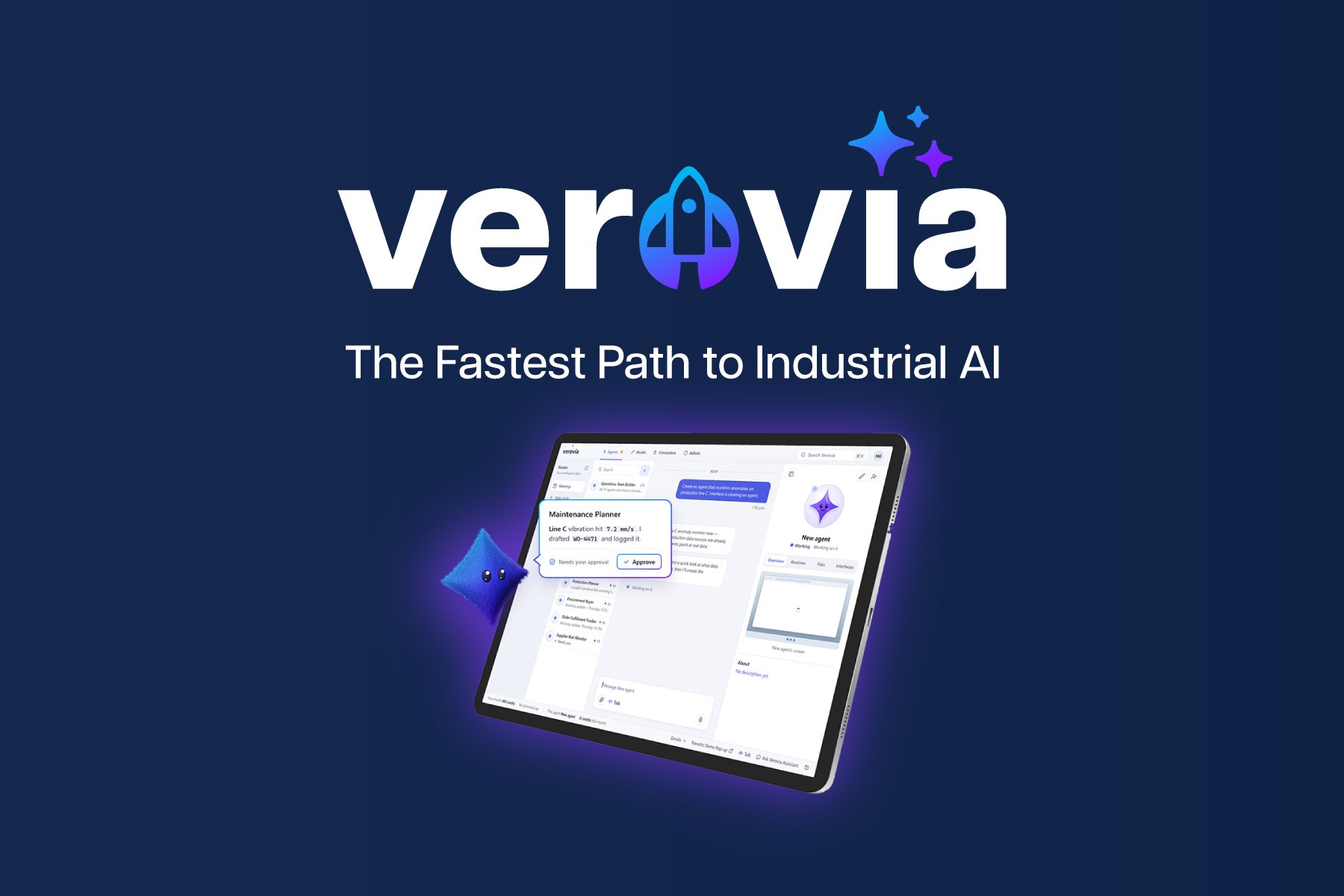
Verovia helps businesses turn information from their existing systems into automated workflows, reducing manual handoffs, connecting teams, and getting work done across operations. From responding to equipment issues to coordinating purchasing and production activities, Verovia helps you act on the data you already have while keeping people in control of critical decisions.
Ready to put your industrial data to work? Try Verovia for free.
Frequently asked questions about industrial AI
What is industrial AI, and how does it work?
Industrial AI is the use of artificial intelligence to analyze industrial data, support decisions, and improve operational processes. It works by using information from equipment, sensors, production systems, and business applications to identify patterns, predict potential issues, and recommend or support actions.
How is industrial AI different from generative AI and enterprise AI?
Industrial AI focuses on applications involving industrial equipment, processes, and operations. Generative AI creates content and can help interpret information, while enterprise AI supports broader business activities. These categories overlap, and industrial businesses can use generative and enterprise AI capabilities within their operational workflows.
What are practical industrial AI use cases beyond predictive maintenance?
Industrial AI use cases include production quality monitoring, energy management, inventory planning, purchasing, supply chain management, and logistics. These applications use operational and business information to identify problems, support decisions, and improve processes across different departments.
How can industrial AI work with SCADA, IoT, and ERP systems?
Industrial AI can analyze information from SCADA systems and IoT sensors alongside business data from ERP applications. This allows organizations to evaluate equipment conditions, inventory availability, production requirements, and other factors together. Connected AI agents can also use this information to initiate permitted tasks and workflows.
What do industrial businesses need to move AI projects from experimentation to production?
Businesses need reliable data, secure access to existing systems, clearly defined objectives, and appropriate governance. They should also test how AI performs under realistic operating conditions, establish human approval requirements, and measure business outcomes before expanding the application to additional processes.