OEM Meaning: How to Choose Parts and Prevent Downtime
What does OEM mean in manufacturing? Learn how maintenance teams evaluate OEM parts, compare them with aftermarket alternatives, manage spare parts inventory, and balance cost, compatibility, availability, and downtime risk.
What you will learn in this article:
What OEM means in manufacturing and how original equipment manufacturer parts apply to equipment maintenance.
The difference between OEM parts and aftermarket parts, including cost, compatibility, warranty, and downtime considerations.
When maintenance teams should use OEM parts versus approved replacement parts.
How to manage OEM parts and spare parts inventory to reduce stockouts and control costs.
How to track OEM part usage, warranties, and serial numbers through maintenance and EAM workflows.
Original equipment manufacturers, or OEMs, play an important role in industrial production and equipment maintenance. Maintenance teams cannot afford to ignore OEM because specifying the correct replacement part can affect compatibility, warranty coverage, downtime risk, and lifecycle cost.
This article explains what OEM means, how OEM parts compare with aftermarket alternatives, and how maintenance teams can manage OEM parts in inventory, track their usage, and balance cost against reliability and availability.
What does OEM mean in manufacturing?
In manufacturing, an OEM designs and sells equipment under its own brand, even when some components are produced by other suppliers. Those suppliers may manufacture parts according to the OEM’s specifications, and the term OEM is sometimes used more broadly to include approved parts suppliers.
An OEM typically defines the design, performance requirements, and specifications for the finished equipment.
Component manufacturers may supply parts specifically designed or approved for use in that equipment.
OEM parts generally follow the original drawings, material specifications, tolerances, and quality requirements established for the equipment.
Example: A motor installed in a compressor may be considered an OEM-specified part when the compressor manufacturer supplies or approves that motor for the application. The company producing the motor is the component manufacturer.
For maintenance teams, understanding this distinction helps confirm that a replacement part meets the equipment manufacturer’s requirements rather than relying on brand name alone.
Why do maintenance teams care about OEM parts?
Maintenance teams use OEM parts to support fit, compatibility, equipment performance, warranty requirements, and regulatory compliance. Genuine OEM parts can reduce uncertainty because they are produced or approved for a specific equipment design.
Compatibility and interchangeability: OEM parts are designed to match the equipment’s original tolerances, connections, dimensions, and operating conditions.
Warranty and contract requirements: Using OEM or approved replacement parts may be required by an equipment warranty, maintenance contract, or service agreement.
Safety and regulatory compliance: Some regulated equipment requires parts with specific approvals, certifications, or traceability.
Traceability and quality documentation: OEMs and authorized suppliers may provide serial numbers, batch records, test results, and certificates of conformity.
Risk reduction: Correctly specified OEM parts can reduce uncertainty around fit, material quality, and expected performance.
A non-OEM part does not automatically void for every warranty. The effect depends on the warranty terms, applicable laws, and whether the replacement part caused or contributed to the failure. Maintenance teams should review the equipment warranty, service agreement, and regulatory requirements before choosing a substitute.
OEM parts vs aftermarket parts: When should maintenance teams use OEM parts?
Maintenance teams should use OEM parts when compatibility, warranty requirements, regulatory approval, or the criticality of the equipment outweighs the additional purchase cost.
Aftermarket parts can be a practical alternative when the supplier is qualified, the part has been validated for the application, and the potential cost savings justify the remaining risk.
Comparison of OEM vs aftermarket parts
Decision checklist:
Identify criticality: classify the part.
Check warranty and regulatory clauses in equipment contracts.
Confirm part number, revision, specifications, dimensions, materials
Validate aftermarket performance via lab or field testing if considering non-OEM.
Verify the supplier and parts traceability to reduce counterfit risk.
Factor total cost of ownership: purchase price and expected downtime cost from failure.
How to evaluate OEM cost against downtime risk
Maintenance teams can compare the higher purchase price of an OEM part with the additional failure risk of an alternative. One way to do this is to estimate the expected cost of failure:
Incremental expected failure cost = additional probability of failure × (direct repair cost + downtime cost + collateral damage cost)
The calculation should use the difference in failure probability between the two options, rather than the total probability that either part will fail.
Example:
An aftermarket gasket saves $50 but is estimated to increase the annual probability of failure by 2%. If a failure causes four hours of downtime at $2,500 per hour:
Incremental expected annual downtime cost:
0.02 × (4 × $2,500) = $200
The aftermarket gasket saves $50 upfront but adds $200 in expected downtime cost.
Net expected disadvantage of the aftermarket option:
$200 − $50 = $150 per year
Based on these assumptions, the OEM gasket has the lower expected total cost.
How to manage OEM parts in inventory
To manage OEM parts in inventory, treat them as controlled maintenance inventory with complete part master data, criticality classifications, equipment links, and tailored reorder rules to balance cost, availability, and downtime risk.
Inventory setup and configurations
Maintain accurate part data
Record the OEM, part number, approved suppliers, compatible assets, substitutes, lead time, shelf life, and warranty or serial-tracking requirements. Link each part to the relevant asset records and bills of materials.Set inventory levels based on risk
Classify parts according to asset criticality, downtime impact, demand, lead time, and availability. Use safety stock, reorder points, or min/max levels to reduce stockouts without carrying unnecessary inventory.Plan for supply and lifecycle risks
Maintain approved vendors and emergency sourcing procedures. Consider blanket orders, consignment, repairable spares, and preassembled kits for critical parts. Track superseded and obsolete OEM parts so replacements can be planned before availability becomes a problem.
Safety-stock calculation:
Safety stock = z × σLT
Where:
Z is the service-level factor.
σLT is the standard deviation of demand during lead time
Example safety-stock calculation
4. Reorder point (ROP)
The reorder point represents the quantity at which replenishment should begin.
Reorder point = average demand during lead time + safety stock
5. Minimum, maximum, and economic order quantity (EOQ)
Use EOQ for cost optimization when demand is stable, and ordering and holding costs are known.
EOQ = √((2 × D × S) ÷ H)
Where:
D is annual demand.
S is the cost of placing one order.
H is the annual holding cost per unit.
6. Procurement and contract configurations
Maintain approved vendor lists with OEM and authorized distributors.
Use blanket POs or call-off contracts for long lead-time OEM parts.
Consider consignment or vendor-managed inventory (VMI) for high-cost critical parts.
Record actual supplier lead time and lead-time variability.
Define escalation procedures for delayed or incomplete orders.
7. Storage and handling
Store controlled OEM inventory in clearly identified locations.
Use first-in, first-out inventory rotation for time-sensitive components.
Apply environmental controls for parts affected by moisture, temperature, vibration, or contamination.
Label inventory with OEM part numbers, internal item numbers, and cross-reference codes.
Restrict access to high-value, safety-related, or serialized components when needed.
8. Obsolescence and lifecycle management
Track lifecycle status such as Active, Limited Availability, Last-Time Buy, and Obsolete.
Maintain cross-references to superseded OEM parts and authorized replacements.
Review spare-parts requirements before equipment becomes unsupported.
Coordinate last-time-buy decisions with the asset’s remaining useful life and replacement plan.
9. Kitting and spare kits
Create repair kits containing parts normally consumed together.
Include OEM parts, seals, fasteners, consumables, and required documentation.
Pre-stage kits for shutdowns, planned outages, and recurring maintenance tasks.
Link kits to bills of materials and standard job plans.
10. Emergency policies
Define when expedited procurement is allowed.
Establish an emergency purchase-order process.
Identify approved distributors and backup suppliers.
Document when an aftermarket or equivalent part may be used temporarily.
Require engineering, safety, or compliance approval before using an emergency substitute on critical equipment.
How do you calculate safety stock and reorder points for OEM parts?
To calculate safety stock and reorder points, use demand variability during lead time and required service level to compute safety stock. Add expected demand during lead time to get reorder points for OEM parts.
Steps to calculate safety stock:
Calculate average demand per day or per planning period.
Calculate the standard deviation of demand.
Determine expected demand during lead time:
Average demand during lead time = average daily demand × lead time
If lead time is fixed and daily demand is independent, calculate the standard deviation during lead time:
σLT = √lead time × σdaily
Calculate safety stock:
Safety stock = z × σLT
Calculate the reorder point:
Reorder point = average demand during lead time + safety stock
How do maintenance teams track OEM parts?
Link every OEM part transaction to a work order, asset, location, and serial number when applicable. This creates the traceability needed to support warranty claims, investigate failures, and understand maintenance costs.
An enterprise asset management (EAM) system centralizes this information by connecting parts, inventory, work orders, asset records, and maintenance history into one system. This gives maintenance teams a clearer view of where OEM parts are used, how often they are replaced, and how part decisions affect asset performance and cost.
Best-practice workflow:
Part issue: The technician scans a barcode or enters the OEM part number when issuing the part to a work order.
Serial tracking: For serialized parts, capture the serial number, installation date, and receiving asset.
Work order closure: Record the removed part, installed part, failure condition, test results, and supporting photos or certificates.
Warranty flagging: If the part is under warranty, trigger a warranty claim workflow with the purchase order, invoice, installation date, and failure evidence.
Analytics: Review failure, replacement, warranty, supplier, and batch trends by OEM part number.
Example workflow:
A planned work order is created using a bill of materials with OEM part numbers.
The storeroom picks the required kit and scans each part into the kitting transaction.
The kit and its parts are linked to the work order.
The technician installs the part and records its serial number against the asset.
The system updates inventory and applies the part cost to the work order.
The warranty period begins when applicable.
The removed component is recorded for repair, return, warranty review, or disposal.
What policies and contracts reduce OEM part risk?
A combination of supplier agreements, SLAs, consignment, blanket orders, and approved alternative policies are used to reduce lead-time and availability risk.
Practical contract and policy options:
Lead-time service-level agreements with escalation terms for critical parts.
Consignment stock for expensive or essential OEM parts.
Blanket purchase agreements with scheduled or on-demand releases.
Authorized distributor lists to support traceability and reduce counterfeit risk.
Lifecycle and obsolescence clauses, including last-time-buy notifications.
Price-protection or escalation clauses for long-term supply.
Repair-and-return agreements for rebuildable components.
Emergency sourcing and expedited shipping terms.
Required documentation for certificates, serial numbers, test results, and warranty claims.
Common OEM parts inventory pitfalls and how to avoid them
The most common pitfalls are poor part master data, missing lead-time information, lack of criticality classification, and weak supplier agreements. Each has straightforward fixes:
Poor part data: Require OEM part number, manufacturer, supplier, lead time, equipment compatibility, and approved substitutes in the part master.
Hidden lead times: Measure lead time from purchase-order release to receipt and include variability in inventory planning.
No criticality scoring: Use a cross-functional review involving maintenance, operations, engineering, procurement, and safety.
Single-source exposure: Identify authorized alternatives, backup suppliers, repair options, or consignment agreements.
Warranty gaps: Capture proof of purchase, installation date, serial number, work order, and failure evidence when the transaction occurs.
Uncontrolled substitutions: Require approval before technicians or buyers replace an OEM part with an unverified alternative.
Duplicate part records: Use manufacturer numbers and cross-references to prevent the same component from being stocked under several item numbers.
How do OEM parts affect spare parts inventory costs and turnover?
OEM parts may have a higher unit cost and longer lead times, which can increase carrying costs when maintenance teams hold too much inventory. However, holding too little inventory can increase downtime risk. Maintenance teams should aim to minimize holding costs while keeping the required service level.
Use ABC analysis to classify parts by annual consumption value.
Combine ABC analysis with a separate equipment or maintenance criticality classification.
Use consignment, supplier-held stock, or vendor-managed inventory to reduce internal inventory value.
Monitor inventory turnover, stockout frequency, lead time, emergency orders, and obsolete stock.
Review high-cost parts with low turnover to determine whether they should be stocked, consigned, repaired, or purchased on demand.
Confirm that an on-demand strategy can deliver the part within the asset’s maximum tolerable downtime.
Manage OEM parts and maintenance inventory with TAG Mobi
Effective OEM parts management depends on connecting inventory, assets, work orders, suppliers, warranties, and maintenance history. An EAM system gives maintenance teams the visibility needed to track part usage, prevent stockouts, and make better replacement decisions.
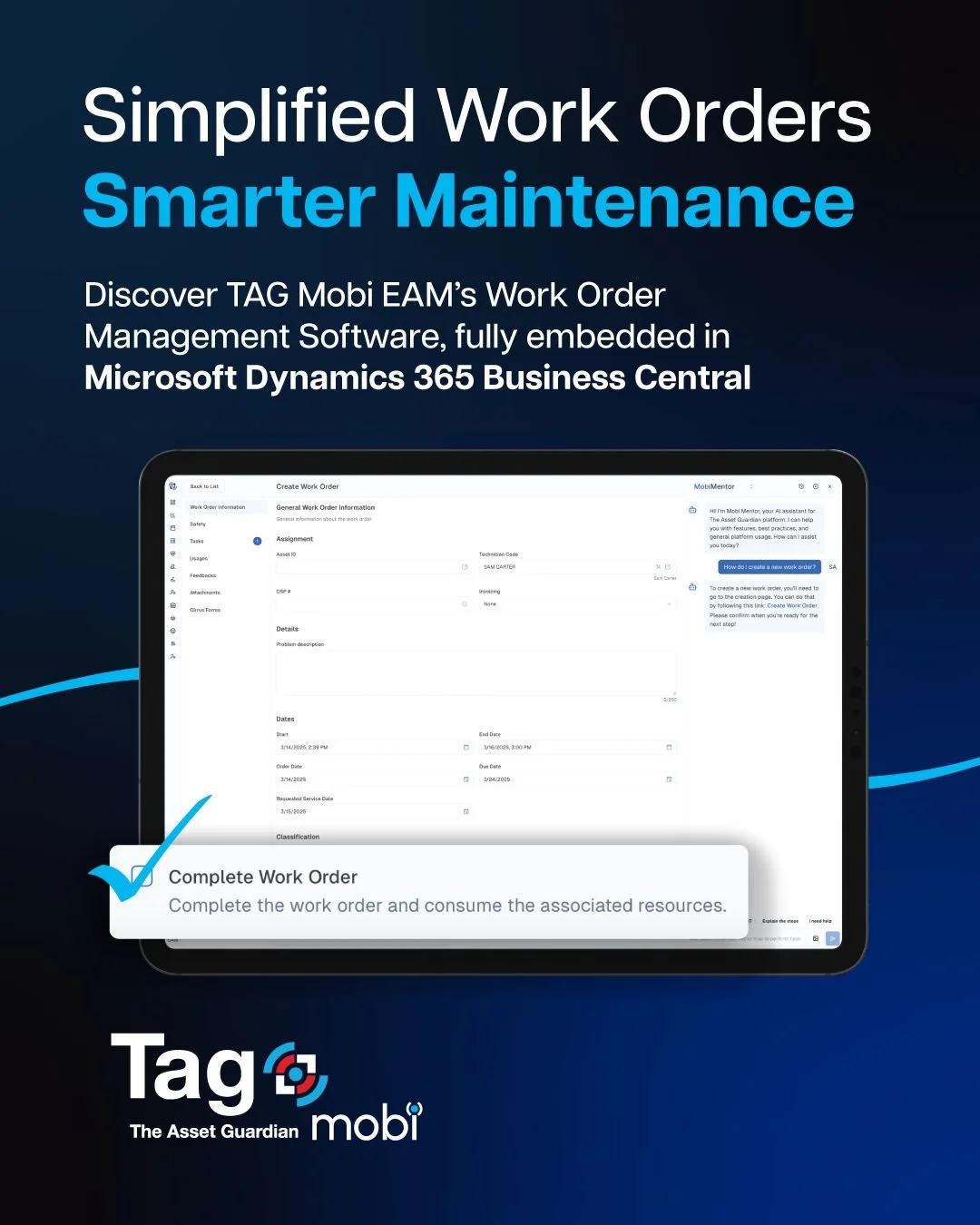
TAG Mobi helps teams manage parts and maintenance workflows within Microsoft Dynamics 365 Business Central. Track inventory, link parts to assets and work orders, and monitor costs from one connected system.
Explore TAG Mobi to see how connected asset, work order, and spare parts management can support better OEM parts decisions.
FAQ
What does OEM mean in manufacturing?
OEM stands for original equipment manufacturer. In manufacturing, an OEM is the company responsible for designing, producing, or assembling equipment that is sold under its own brand.
OEMs establish the original specifications for equipment and replacement parts, including dimensions, materials, tolerances, and performance requirements. Understanding the OEM meaning in manufacturing helps maintenance teams identify compatible parts and evaluate whether an alternative meets the equipment’s technical requirements.
What are OEM parts in maintenance?
OEM parts are replacement parts made by the original equipment manufacturer or an authorized supplier according to the equipment’s original specifications.
Maintenance teams use OEM parts to support fit, compatibility, traceability, warranty requirements, and reliable equipment performance. OEM parts may cost more than aftermarket alternatives, but they can reduce uncertainty when a component is critical, highly specialized, or subject to regulatory or warranty requirements.
What is the difference between OEM and aftermarket parts?
OEM parts are made or approved by the original equipment manufacturer, while aftermarket parts are produced by another supplier as an alternative.
OEM parts generally provide greater certainty around fit, specifications, and documentation. Aftermarket parts may offer lower costs, shorter lead times, or broader availability, but maintenance teams must verify their quality, compatibility, warranty impact, and suitability for the application. The best choice depends on equipment criticality, downtime risk, part availability, and total cost.