How Reliability and Maintenance Improve Engineering Asset Management
“Reliability and maintenance have evolved from operational necessities into strategic pillars of engineering asset management.”
Dragan Komljenovic, ing., Ph.D., and Jean Raymond, ing., Ph.D., M.Sc.
What you will learn in this article:
In this article, based on the expert white paper by Dragan Komljenovic, ing., Ph.D., and Jean Raymond, ing., Ph.D., M.Sc., you will learn:
Why reliability and maintenance are strategic parts of engineering asset management
How maintenance strategies help reduce downtime and improve asset availability
Why different assets require different maintenance approaches
How reliability, risk, and maintenance data support lifecycle decisions
How AI, IoT, SCADA, analytics, and digital twins support predictive maintenance
What a real manufacturing case study reveals about improving OEE and maintenance performance
For asset-intensive organizations, reliability and maintenance are no longer just day-to-day operational functions. They influence asset availability, lifecycle cost, operational risk, resilience, and long-term value.
In their white paper, Reliability and Maintenance as an Integral Part of Engineering Asset Management, Dragan Komljenovic, ing., Ph.D., and Jean Raymond, ing., Ph.D., M.Sc., describe this evolution clearly:
“Reliability and maintenance have evolved from operational necessities into strategic pillars of engineering asset management.”
If you are responsible for uptime, production, or asset performance, you already know the challenge. One unexpected failure can affect schedules, safety, maintenance costs, customer commitments, and the team’s ability to stay ahead of the next issue.
This article highlights the paper’s key takeaways and examines how a more strategic approach to reliability and maintenance can strengthen asset performance.
Learn how to strengthen reliability and maintenance
Reliability and maintenance help asset-intensive organizations move from reactive work to better planning, better decisions, and stronger operational performance.
Reduce downtime
Maintenance teams need to prevent, detect, and respond to asset failures before they disrupt operations. Reliability and maintenance strategies help reduce unplanned downtime, improve system performance, and give teams a clearer path from failure risk to action.
Improve asset availability
Critical assets need to perform when operations need them most. Reliability-focused maintenance helps teams improve equipment availability, reduce recurring failures, and prioritize work based on asset criticality and operational impact.
Make better lifecycle decisions
Maintenance decisions affect more than today’s work orders. Reliability, risk, and maintenance data can help guide repair, renewal, replacement, and long-term asset planning. The white paper explains that reliability and maintenance are embedded throughout the full asset lifecycle, from planning and design to operations, renewal, replacement, and disposal.
Stop treating maintenance like a cost center
Maintenance is often viewed as a cost to control. But in engineering asset management, maintenance plays a much larger role.
It affects asset availability, operational risk, lifecycle cost, compliance, resilience, and long-term value. When reliability and maintenance are treated as strategic functions, organizations can make better decisions about where to invest, when to intervene, and how to protect asset performance.
But not every asset deserves the same level of maintenance effort. Some assets can run to failure with little operational impact, while others need closer monitoring because one failure can stop production, create safety risk, or drive major costs.
The white paper summarizes this clearly:
“No single maintenance strategy is universally optimal.”
The right approach depends on the asset. A low-cost, non-critical component may be suitable for corrective maintenance or run-to-failure. A critical production asset may require condition monitoring, predictive maintenance, or a structured reliability analysis.
Use the white paper to strengthen your maintenance strategy
When every asset competes for time, budget, and technician capacity, teams need a clearer way to decide where maintenance effort will have the greatest impact.
✓ How reliability and maintenance fit into engineering asset management
✓ When to use corrective, preventive, condition-based, predictive, RCM, TPM, and RBM strategies
✓ How risk-informed decision-making supports maintenance priorities
✓ How AI, IoT, SCADA, analytics, and digital twins support predictive maintenance
✓ Why data quality, governance, and cross-functional alignment matter
✓ What real case studies reveal across utilities, manufacturing, rail, and mining
The paper explores established methodologies such as reliability-centered maintenance, reliability-based maintenance, condition-based maintenance, total productive maintenance, and predictive maintenance. It also examines the role of data analytics, artificial intelligence, IoT, machine learning, digital twins, cybersecurity, and cross-functional collaboration.
Digital tools can support stronger maintenance maturity
Digital technologies are changing how organizations manage reliability and maintenance.
IoT, IIoT, SCADA, AI, machine learning, digital twins, EAM, and CMMS systems can help teams move from reactive maintenance to more predictive and data-driven approaches. These tools can support continuous monitoring, anomaly detection, predictive maintenance, workflow automation, and risk-informed decision-making.
Digital tools can help teams move faster, but they only create value when they support better maintenance decisions. In this white paper, the authors explain how these technologies support modern maintenance maturity:
“Digital technologies—IoT sensors, analytics, machine learning, digital twins—enable predictive maintenance, real-time condition monitoring, risk-informed decision-making, and scenario-based resilience analysis.”
But technology alone is not enough. The value comes from combining trusted data, strong governance, cross-functional collaboration, and clear maintenance processes.
See how one manufacturer improved OEE by 15%
The white paper includes a real manufacturing case study showing how reliability and maintenance practices can improve operational performance.
A large manufacturing facility was experiencing frequent unplanned downtime caused by operator errors, inadequate lubrication practices, poor maintenance documentation, and lack of root cause analysis.
The organization used total productive maintenance to address these issues, including autonomous maintenance by operators, standardized work procedures, cross-functional teams, root cause analysis, and performance dashboards.
The result: 15% higher overall equipment effectiveness (OEE), fewer minor stoppages and micro-failures, a stronger reliability culture, and better collaboration between operations and maintenance.
Want to improve your overall equipment effectiveness?
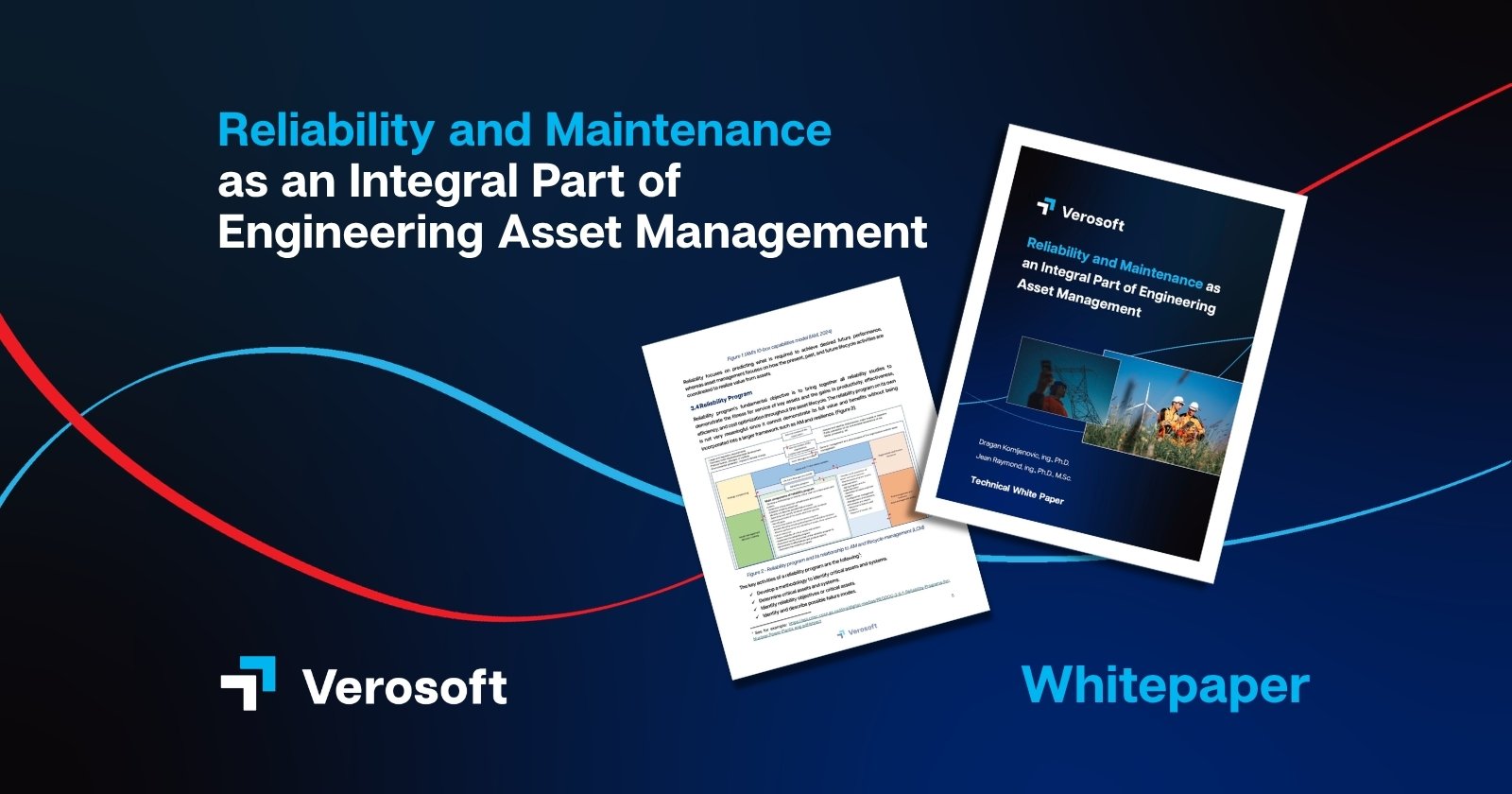
Download the full white paper
Explore the frameworks, methodologies, and case studies behind modern reliability and maintenance in engineering asset management.